An outdoor payment terminal is not simply a self-service kiosk moved outside. It is a distinct category of equipment designed from the ground up for an entirely different set of conditions: frost below −20 °C, heavy rain, direct sunlight, and a highly varied audience — including those who test devices “for durability” with their hands or something heavy. An ordinary indoor self-service checkout unit would not survive there: the housing cracks from temperature swings, the screen becomes unreadable in sunlight, and moisture finds any unsealed port.
Elpix manufactures outdoor terminals in Ukraine. After several years of supplying parking lots, gas stations, shopping centres, and industrial facilities, the questions that arise during equipment selection are well understood: what IP65 means, how heating functions at −30 °C, what anti-vandal housings are made of, and why 1,500 cd/m² brightness is a genuine technical function — not a marketing claim. Below are concrete answers without advertising promises: specifications, real-world use cases, and what actually matters before placing an order.
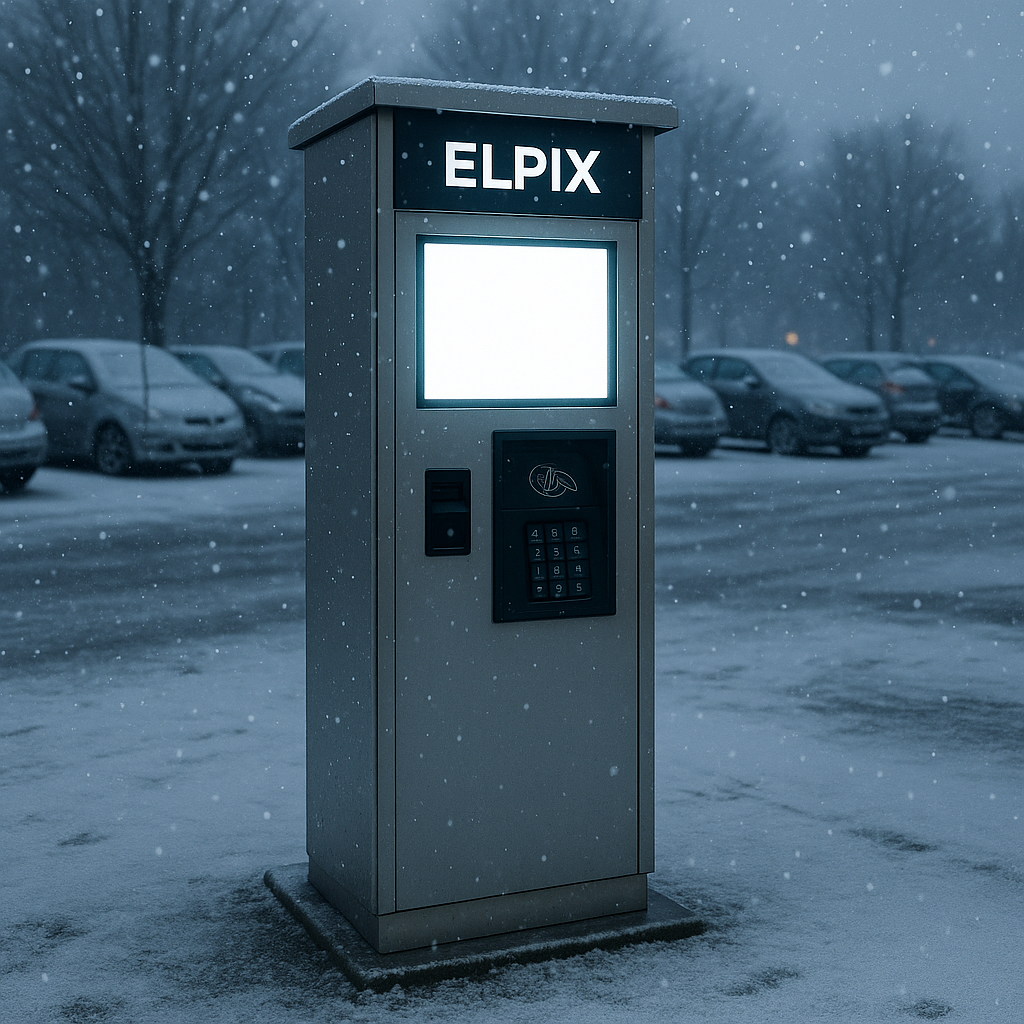
An outdoor payment terminal is an autonomous kiosk that accepts card, NFC, or cash payments without a cashier and operates outside a heated building. It stands in a parking lot, at a shopping centre entrance, on a gas station island, or at the entry of a residential complex — where winter temperatures drop below zero and summer sun heats the screen surface to 60 °C.
Structurally it is a full-featured payment kiosk, built differently from indoor counterparts. Inside: an industrial-grade computer (not a consumer device), a climate control system (heating in winter, heat dissipation in summer), and sealed cable entries. The display is a High Bright panel with brightness starting at 1,500 cd/m², because a standard office monitor outdoors becomes unreadable even on an overcast day. The housing is steel from 2 mm thick with an IP65 or higher ingress protection rating. The touchscreen works with gloves on — otherwise it simply would not be usable during a Ukrainian winter.
For a business, an outdoor terminal solves a specific problem: accepting payments where opening a staffed checkout is impractical or physically impossible. No booth to build, no operator to hire, no cabling required for room heating. The terminal stands outside and works on its own.
The difference between an outdoor and an indoor terminal is not form factor — it is engineering. Externally an outdoor and a retail kiosk may look similar, especially on manufacturer websites. But placing an ordinary indoor terminal outside and expecting normal operation is a costly mistake. Condensation destroys the circuit board after the first thaw. The screen freezes or fades. The eventual cost of replacing the entire housing exceeds the price difference of buying correct equipment from the start.
Typical outdoor terminal deployment locations in Ukraine:
The IP (Ingress Protection) marking describes two levels of protection: against solid particles and against water. The first digit is dust, the second is moisture. IP65 means: dust does not penetrate at all (6), and the housing withstands direct water jets from any direction (5). For outdoor use, this is the baseline requirement.
| IP Rating | Dust Protection | Water Protection | Where Applied |
|---|---|---|---|
| IP42 | Particles >1 mm | Drips from above (up to 15°) | Indoor, retail floors, enclosed spaces |
| IP54 | Partial dust protection | Splashes from any direction | Canopies, semi-open areas, covered stops |
| IP65 | Full dust-tight | Water jets from any direction | Outdoors, gas stations, parking lots — outdoor standard |
| IP66 | Full dust-tight | High-pressure water jets | Car wash facilities, industrial zones |
| IP67 | Full dust-tight | Submersion to 1 m for 30 min | Specialised applications |
IP65 is the minimum threshold for an outdoor terminal. Rain, snow, a nearby car wash, a garden hose — it must withstand all of these without consequence. IP66 and above are required at industrial wash facilities where housings are regularly cleaned under high pressure, or near process zones with water spray. For a standard parking lot or gas station, IP65 is sufficient and is the industry-recognised outdoor standard.
The weak point of any housing is not the metal itself, but the joints and cable entries. A housing rated IP65 as a complete assembly can still allow moisture ingress if cable glands are substandard or joints are not properly gasketed. Elpix seals both with industrial gaskets and watertight cable glands. Without this attention to detail, even an IP65 housing will eventually allow moisture to reach the circuit board — typically after the first freeze-thaw cycle of the season.
“Every Elpix outdoor terminal is assembled with watertight cable entries and sealed housing joints. The IP65 rating is not just a label — it is a real factory test performed on every unit before shipment.”
Cold is the primary challenge for outdoor electronics. LCD panels lose contrast already at −10 °C. Electrolytic capacitors on circuit boards degrade over repeated cold cycles. A receipt printer in frost simply refuses to feed the roll. The touchscreen stops responding to gloved touches — which in a Ukrainian winter is the only way most people interact with outdoor equipment.
Elpix outdoor terminals address these issues through an active heating system. Inside the housing sits a heating element with a thermostat controller. When temperature drops below a set threshold, heating activates automatically. The electronics operate within a stable range even at −30 °C outside. This is not “cold-resistant” in the marketing sense — it is a real, specified operating range: −30…+55 °C.
An important detail often overlooked during planning: condensation during sudden thaws. If the temperature is −15 °C in the morning and +5 °C by midday — the temperature differential between the inside and outside of the housing causes moisture condensation. In a properly engineered terminal this is accounted for: ventilation routes are designed so condensate does not settle on the main control board. In a terminal without proper climate engineering, this creates gradual electronics failure that is difficult to trace without opening the unit.
In summer the problem reverses: heat dissipation. On a hot sunny day the exterior housing warms up, and the internal temperature rises above the ambient. This is especially pronounced in southern Ukrainian regions: a housing standing in direct sunlight in the Kherson or Zaporizhzhia oblasts in July can reach 70–80 °C on the outer surface. Electronics must not operate at such temperatures without heat removal paths. Elpix outdoor terminals therefore incorporate heat dissipation through a radiator or a ventilated base panel — without direct external openings that would allow moisture ingress.
The heating system affects electrical sizing — a detail that catches many facility managers off guard. A standard outdoor terminal consumes 200–350 W in normal operating mode. With active heating engaged at peak winter demand, consumption reaches 600–800 W. Plan the electrical feed, circuit breaker size, and cable cross-section for the peak figure, not the average.

Vandalism is not only intentional. It also encompasses a sharp impact from a bag or shopping cart, someone trying to pry a panel edge with a fingernail, or a user pressing the screen with maximum force because they believe it is not registering their touch. Outdoors, the terminal faces all of this without security staff present. According to parking system operators in Eastern Europe, an outdoor terminal receives physical impact from users three to five times more frequently than an indoor kiosk. Not a surprising statistic — simply a fact worth factoring into equipment selection from the beginning.
Anti-vandal protection in Elpix outdoor terminals is engineered in multiple independent layers.
Screen glass. Tempered glass, 6–10 mm thick. Tempering increases impact resistance by five to six times compared to ordinary glass. When broken (which happens rarely), tempered glass shatters into small, blunt fragments rather than sharp shards — an important safety consideration for people in the vicinity. Optional upgrade: laminated safety glass, which holds fragments on an interlayer film and does not fall from the frame on impact. The sensible choice for high-traffic or high-risk locations.
Housing. Cold-rolled steel, 2–3 mm thick. Not decorative sheet metal that bends under a fist blow. Finish: powder coating applied over a primer layer. Chips and scratches do not expose bare metal to rust as quickly as they do with conventional paint systems. Housing corners are radiused without sharp edges — reduced injury risk and fewer points that can be levered or pried open.
Fasteners and locking mechanisms. External bolts are recessed or covered with protective caps. The service compartment opens only with a proprietary key or a non-standard socket profile tool. Without the specific tool, it cannot be opened. On request, a tamper detection sensor is installed: if the housing is opened without authorisation, the system sends a notification to the operator’s phone or email within seconds. Service doors can also be fitted with electronic locks with full access audit logs — every opening is recorded with a timestamp. For gas station and parking networks where multiple contractors service the equipment, this provides accountability and chain-of-custody tracking.
Surveillance camera. Optional built-in camera, positioned to capture the user’s face during each transaction. Useful both as an investigation tool after incidents and as a visible deterrent for those inclined to test the housing’s resilience. Footage is stored on an internal drive or transmitted to cloud storage, depending on configuration and data retention requirements.
Impact sensor. On request — an accelerometer mounted inside the housing. If the terminal receives a sudden impact above a configurable threshold, it sends an automated alert to the operator. This enables a rapid response before damage becomes irreversible, and also builds a log of impact events that can reveal patterns in problem locations.
A detail frequently overlooked in planning: anti-vandal construction does not eliminate the need for careful thinking about installation method. A terminal bolted four ways to a wooden deck can be pried loose, and removal is physically feasible. Anchor mounting into a concrete foundation or a steel embedment cast into asphalt is an entirely different proposition. Elpix provides detailed mounting specifications and recommendations with every order.
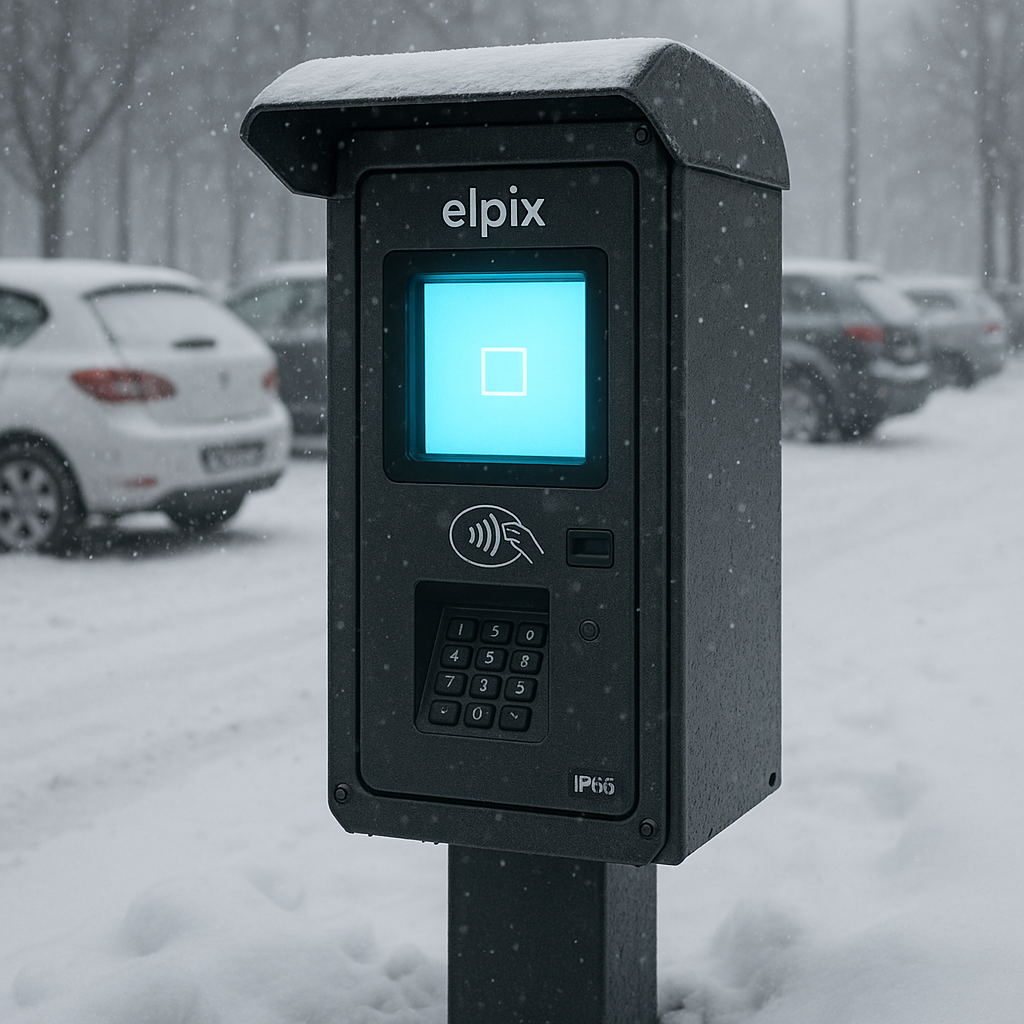
This is one of the most practical specifications and one of the least discussed in purchasing conversations. A standard office monitor delivers 250–350 cd/m². In direct sunlight it becomes a mirror — nothing is legible. Even 500 cd/m² reads poorly in direct outdoor exposure during summer daylight hours.
Elpix outdoor displays start at 1,500 cd/m², with flagship configurations reaching 2,500 cd/m² and above. In practice this means the screen remains readable at any time of day in any weather. In the morning when the sun strikes the screen at an acute angle. In the afternoon heat of summer. On snow-covered ground reflecting light like a mirror, which is often the harshest real-world condition for screen readability.
Technically, a High Bright display is a standard LCD panel with an enhanced backlight and an anti-glare surface coating. Anti-glare glass scatters reflected ambient light instead of mirroring it directly into the user’s eyes. These are two separate technologies that work together — and good outdoor screens combine both rather than relying on backlight brightness alone.
| Brightness (cd/m²) | Outdoor Readability | Recommended Application |
|---|---|---|
| 250–500 | Indoor use or deep shade only | Indoor kiosks, offices, enclosed lobbies |
| 700–1,000 | Semi-open areas, canopies, night use | Covered atriums, indoor parking decks, vestibules |
| 1,500–2,000 | Full outdoor, most use cases | Parking lots, gas stations, bus stops — standard |
| 2,500–3,000 | Direct southern sun, snow and wet-surface glare | Open-air fuel islands, exposed stadiums, high-latitude installations |
An important power consumption note: a brighter screen draws more electricity. At 2,500 cd/m², the backlight adds approximately 50–80 W to total consumption compared to a 1,500 cd/m² panel. A modest figure on its own, but worth knowing before finalising the power supply and cable sizing for the installation.
“At an open-air gas station in the Kherson region in summer, we installed terminals with 2,000 cd/m² displays. Users read the interface clearly even on the brightest days — zero complaints about screen readability from the day of commissioning.”
Which payment methods the terminal supports is no less important a question than IP65 rating or frost resistance. The answer depends entirely on the site audience and operating scenario. A downtown Kyiv car park and a regional town gas station have entirely different payment module requirements.
Bank card (POS terminal). The baseline function of any modern payment kiosk. Chip-and-PIN, contactless payment — all processed via an integrated POS module connected to the acquirer through a secure encrypted channel. To operate, a merchant acquiring agreement and PCI DSS Level 1 equipment certification are required — without the latter, an acquiring bank will not connect the terminal to its system. Verify certifications with any manufacturer, not only Elpix. This is not a formality; it is a real filter that eliminates non-compliant equipment at the acquiring setup stage.
NFC and mobile payments. Apple Pay, Google Pay, Samsung Pay — all smartphone and smartwatch payment methods operate through the same contactless EMV reader as a physical card. For the end user: hold the device to the reader, payment is completed. Outdoors in winter, contactless NFC payment is especially practical: no need to remove a card from a wallet while wearing gloves, and no direct physical contact with the terminal surface in cold or wet conditions.
QR code. Two distinct implementation scenarios: a QR code displayed on the terminal screen (the user scans with a phone camera and pays through a banking app or Portmone), or a QR scanner built into the terminal (the user presents a QR code on their phone, the terminal reads it). The first variant is simpler and less expensive, requiring no additional hardware. The second suits specialised loyalty systems, prepaid tickets, or subscription cards. Monobank, PrivatBank, PUMB, and most major Ukrainian banks support QR payment flows — the user base for this method is substantial and growing.
Cash. A banknote acceptor is a separate module that significantly increases both the mechanical complexity and the cost of the terminal. For certain locations it is nonetheless essential: gas stations in smaller towns where card adoption is lower, parking lots without reliable internet connectivity, public transport stops. Elpix banknote acceptors handle denominations across the full range in circulation and can dispense change depending on configuration. Cash handling maintenance — collection and cleaning cycles — is more frequent than for card-only terminals. This operational cost should be factored into the configuration decision for each specific site.
Transit cards and facility access systems. For municipal transport operators, residential complexes with access control, or corporate facilities — the terminal can be fitted with a Mifare/ISO 14443 NFC reader for local loyalty cards, prepaid transit cards, or building access passes. This requires additional software integration and customisation but makes excellent sense for transport networks or parking systems operating subscription or season-pass models.
Receipt printer. Standard in most terminal configurations. For gas stations it is mandatory: the customer receives a printed record confirming the amount of fuel dispensed — this is a legal and practical requirement. The thermal print mechanism in an outdoor terminal incorporates a dedicated heater: at −15 °C, standard thermal paper becomes brittle and tears without it, making receipt printing impossible at the temperatures most critical for the application.
An outdoor payment terminal connects to a 220 V mains supply and consumes between 200 and 800 W depending on configuration and ambient temperature. Battery-backed autonomous operation is technically possible but operationally uncommon: battery systems capable of supporting this power draw are bulky, expensive, and require their own maintenance regime.
What genuinely matters for outdoor reliability:
Voltage protection. On parking lots and gas stations, mains voltage fluctuates routinely: large vehicle engine starts create significant transient loads, nearby welding equipment injects noise, and ageing substations in older city districts deliver inconsistent voltage. A terminal without surge and transient protection fails unpredictably and at inconvenient times. Elpix terminals incorporate protection circuitry against voltage fluctuations and brief supply interruptions.
UPS (uninterruptible power supply). An integrated or external UPS allows the terminal to complete an in-progress transaction when mains power is lost and shut down cleanly without data loss or file system corruption. For gas stations, this is particularly important: an interrupted payment transaction can mean a payment dispute, an unactivated pump, or both simultaneously — all of which require staff intervention to resolve.
Power monitoring. Remote monitoring systems record power outage events and notify operators. This enables distinguishing “terminal software has frozen” from “terminal has lost power” — two very different responses are required. For a network of several dozen outdoor terminals, this capability is operational infrastructure, not a luxury feature.
Consumption by operating mode. Standby mode (screensaver active, no transaction): approximately 50–100 W. Active transaction processing: 200–350 W. Active frost protection heating engaged: peak up to 600–800 W. Use the peak figure when calculating cable cross-section and circuit breaker rating — not the average. Undersizing the electrical feed based on average consumption is one of the most common installation errors.
“When connecting an Elpix outdoor terminal, we recommend provisioning a dedicated 16 A circuit with RCD and proper earth bonding. This is not excessive caution — it is the minimum for stable operation at peak winter load.”
Earthing. Mandatory for any metal housing installed outdoors, in contact with a concrete or asphalt surface that may collect moisture. Without proper earthing, the terminal housing can develop hazardous touch voltages — a safety risk for users and a cause of equipment damage. The installation contractor must include an earthing circuit as a non-negotiable element of the installation.
Installing an outdoor terminal is not a set-and-forget exercise. Incorrect installation negates all the design advantages of a protected housing: a terminal rated IP65 but installed with improperly sealed cable entries will accumulate condensation within its first season — the same damage path as an unprotected unit.
Foundation and mounting. A freestanding outdoor terminal is secured with anchor bolts into a concrete foundation or a steel cast-in embedment plate in asphalt. Bolt material: stainless steel or corrosion-resistant coated fasteners — wet asphalt surfaces and winter de-icing salts aggressively corrode ordinary steel bolts, loosening the installation over time. Anchor depth should follow the manufacturer’s specifications for the specific substrate type and expected lateral loads.
Cable entry. Cables enter from below the terminal or through a dedicated conduit channel in the base plate — never from the top and never through open side apertures. Watertight cable glands (PG or M thread type) are used at every penetration point. Each entry is verified for sealing integrity after installation as part of commissioning acceptance. This step is commonly skipped by contractors unfamiliar with outdoor kiosk installation — a mistake that manifests months later as unexplained electronics failures.
Routine maintenance schedule. An outdoor terminal requires scheduled preventive maintenance every 3–6 months, depending on traffic load and site conditions. Standard PM scope:
Remote monitoring. For networks of three or more terminals, a remote monitoring system is operationally essential. A well-implemented monitoring system tracks in real time: device online/offline status, banknote acceptor mechanical state, change cassette fill level, thermal printer error codes, and internal housing temperature against the ambient. Any out-of-range parameter triggers an automatic notification to the responsible operator. This reduces the time from fault occurrence to response from “we heard about it from a customer” to “we knew ten minutes before any customer did.”
Warranty and service terms. Clarify precisely what the warranty covers: parts replacement only, or on-site technician response. For outdoor-deployed equipment, this distinction is operationally significant — a terminal at a gas station thirty kilometres from the nearest service centre is not practical to transport in for bench repair, and the site cannot operate without it. Elpix provides warranty service with technician dispatch across Ukraine.
These three locations represent the most common outdoor terminal deployments in Ukraine, and each has distinct technical and operational requirements that shape equipment selection.
Gas stations. The operational model here is prepayment: the customer selects the pump and fuel grade, enters the amount or volume, and only then does the dispenser activate. The terminal on the fuel island operates outdoors continuously — in summer heat, winter frost, rain, and wind-driven frost. IP65 protection and a −30…+55 °C rated operating range are not “reliability” parameters at a gas station — they are conditions for basic operational continuity. A terminal without these specifications will not sustain 24/7 operation through a Ukrainian winter.
An additional critical factor for gas stations: explosive atmosphere classification. A terminal positioned on a fuel island must comply with equipment requirements for zones containing hydrocarbon vapours. Not all manufacturers hold ATEX certification or its Ukrainian equivalent. Clarify this at the ordering stage: deploying non-certified equipment in a fuel zone creates regulatory liability and genuine fire safety risk. Elpix provides detailed guidance on this topic during model selection consultations.
Parking lots. A parking terminal accepts payment and controls a barrier, or records payment for security staff verification. Typical workflow: entry camera captures the licence plate → driver stops at the terminal → enters the plate manually or scans a QR code from the entry ticket → pays by card or cash → barrier opens. For residential complexes: season pass cards or mobile app integration as alternatives to per-visit payment. Critical operational requirement for parking: the terminal operates around the clock and must maintain a reliably heated start-up state through overnight frost — if the internal temperature drops to −20 °C and the heating has not maintained operating range, the terminal may not respond promptly when the first morning customer arrives.
Elpix supplies parking terminals with pre-built integration to major parking management platforms: Parking Cloud, JetPark, and custom solutions based on 1C. If you operate a different system, this is a discussion item at the specification stage — not a reason to reject the equipment.
Bus stops. A terminal at a public transport stop sells single-trip tickets, tops up stored-value transit cards, or accepts contactless fares — depending on the transit operator’s system. Key requirements: compact form factor that fits within a standard shelter layout, mandatory heating for consistent operation through winter, and NFC reader capable of supporting both bank card payment and transit card top-up in a single unit. Anti-vandal requirements at bus stops are higher than at guarded parking lots or gas stations — stops in peripheral areas are more exposed to night-time damage without deterrence from CCTV or on-site staff.
| Parameter | Gas Station | Parking Lot | Bus Stop |
|---|---|---|---|
| Payment model | Prepayment + pump activation | Payment on exit after parking | Ticket purchase / card top-up |
| Critical protection | IP65 + ATEX vapour zone | IP65 + active heating | IP65 + anti-vandal + heating |
| Operating hours | 24/7 non-stop | 24/7, peak evenings and weekends | 6:00 AM–11:00 PM or 24/7 |
| Cash acceptance | Required | Recommended | Required |
| System integration | Fuel dispenser + card acquiring | Parking management + barrier control | Ticketing platform / transit card system |
“For gas station deployments, we have specific zoning recommendations in line with fire safety regulations. Raise this topic during the ordering consultation — it is not bureaucratic paperwork, it is real site safety.”
The process is straightforward. The essential step is to describe the scenario from the outset — not to select a model from a photograph and hope it fits.
Elpix works this way: you describe the site, installation conditions, customer throughput, and required functions — cash acceptance, parking system integration, custom interface. A technical specialist proposes a configuration and prepares a commercial quotation. This takes one to two business days, not three weeks.
For a single-unit order, confirm stock availability. Some configurations ship immediately from inventory. For a custom build or a larger volume: production cycle is 15–25 working days following specification agreement and deposit payment.
Installation. Elpix does not impose its own installation crews, but strongly recommends engaging specialists with outdoor kiosk experience. Outdoor terminals require foundation or anchor mounting, earthing, and correct cable entry sealing — a skill set that differs meaningfully from installing an indoor retail kiosk. Contractors who have only worked with indoor equipment often miss the sealing details that determine long-term reliability. Elpix provides full mounting requirement documentation and pre-installation consultations at no charge.
After commissioning: warranty service with on-site response, remote terminal health monitoring, and ongoing integration support. This ongoing visibility is especially important for outdoor sites — someone needs to see the parking lot terminal at 11 PM so that a failure does not go undetected until the first angry customer call in the morning.
“Elpix is Ukrainian manufacturing. Housings are fabricated in our own facility; components are sourced from verified suppliers. For orders of three units or more, we offer full customisation: RAL colour to match your brand, logo on the housing, and interface styled to your visual identity. Stock configurations ship immediately. Custom builds: 15–25 working days.”
If you need an outdoor self-service terminal, start with a request for a commercial proposal. Specify the site, your region’s expected temperature range, whether cash acceptance is required, and whether there is a specific system requiring integration. Everything after that is Elpix’s responsibility.
The models closest to typical outdoor use cases can be found here: Self-Service Kiosk U92 Metal (floor-standing steel kiosk) and Terminal U5 (compact touchscreen terminal). For outdoor-rated configurations specifically — request a dedicated consultation. The specification changes meaningfully by site, and a stock product page will not capture all the relevant decisions.
💡 Need an outdoor self-service terminal? Elpix manufactures payment terminals and kiosks in IP65-rated weatherproof housings for outdoor use, parking lots, and gas stations. Installation and service across Ukraine. View all terminals.
View Details

View Details
Open Catalogue