



Choosing a large display usually means choosing between two different technologies. An LCD video wall is built from separate panels with thin bezels. An LED video wall is a continuous canvas of light-emitting modules with no visible seams at all. They look alike only in catalogue photos.
Neither one is simply better. The answer depends on the task, the viewing distance and the budget. LCD costs less on smaller areas and renders fine detail more sharply up close. LED wins on large surfaces, in bright rooms and wherever the canvas has to read as a single image.
Below both technologies are compared on the same criteria: brightness, seam, resolution, service life and maintenance. All figures come from actual Elpix video walls and LED products.
What a seamless video wall really means
The phrase “seamless video wall” is used in two different senses, which is where the confusion starts.
The first sense is LCD panels with a minimal bezel. The joint between neighbouring screens physically exists, but its width is reduced to a thin line. From a few metres away the eye barely registers it, especially when content is split into zones rather than stretched as one frame.
The second sense is an LED canvas, where modules butt together with no frames whatsoever. There is no seam even at arm’s length: the image is continuous across the whole surface. That is what people mean by a truly seamless video wall.
What follows from this: if viewers stand a metre and a half from the canvas, choose LED. If they watch from five to eight metres and the content is laid out in windows, the thin LCD joint will not get in the way.
LCD video wall: when panels are enough
An LCD build is a set of professional panels under a shared controller. Elpix video walls use 55-inch displays with an LCD Video Wall Display matrix and D-LED backlight.
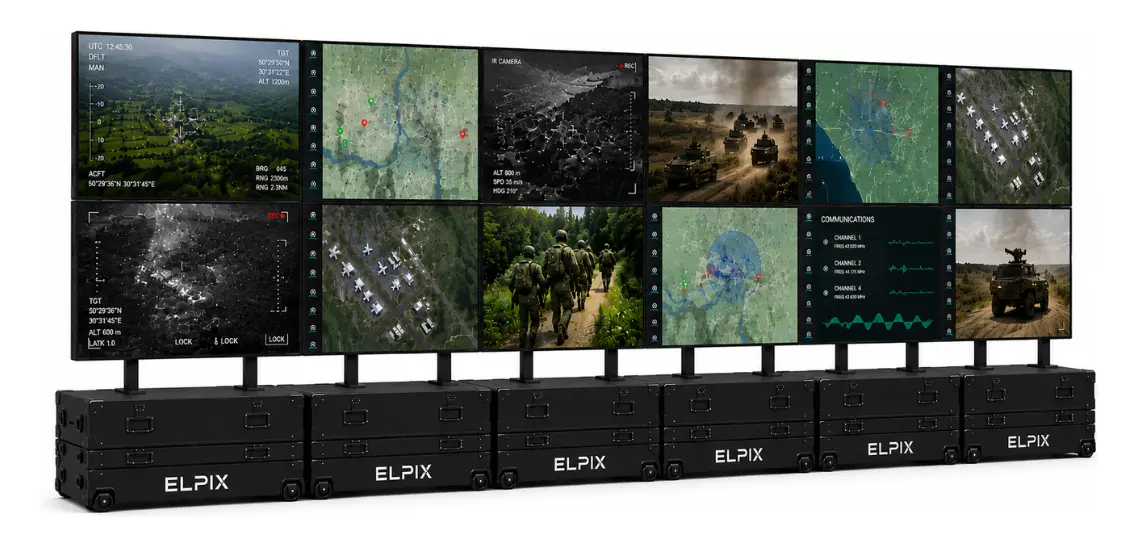
- Resolution: Full HD 1920×1080 per panel, adding up across the canvas — 3840×2160 in a 2×2 build, 11520×2160 in a 6×2
- Brightness: 500 cd/m², twice that of a consumer television
- Viewing angles: 178° / 178°
- Response time: 8 ms, contrast 1200:1 / 5000:1
- Colour: 1.07 billion shades, 10-bit, NTSC 72% gamut
- Structure: transport cases holding two displays each, scaling up to 16 screens
The strength of LCD is pixel density. At arm’s length, text in a table reads without effort because the pixel is small. For a control room where the operator sits a metre from the screen watching numbers, that settles the argument.
The weakness is just as clear — the joint. It never disappears; it can only be made thinner. If a single continuous image with fine lines runs across the canvas, the grid of joints will show.
What follows from this: LCD suits data and windows rather than full-surface video. Maps, tables and several camera feeds are its scenario.
LED video wall: a continuous canvas without frames
An LED wall is assembled from modules that butt directly against each other. Instead of a backlit matrix, the diodes themselves form the image. Hence a different set of numbers.
Elpix LED products come in two pixel pitches — 1.5 mm and 2.5 mm. Pixel pitch decides from how far away the picture looks continuous: the smaller it is, the closer a viewer can stand.
- Brightness: up to 800 cd/m², and up to 1000 cd/m² on some models — shop-window territory
- Refresh rate: 3840 Hz, so a camera picks up no flicker when filming the screen
- Viewing angles: 140°, and 160° on the P2.5 model
- Service life: over 100,000 hours
- Protection: IP30, and IP31 on the P2.5 — indoor rating
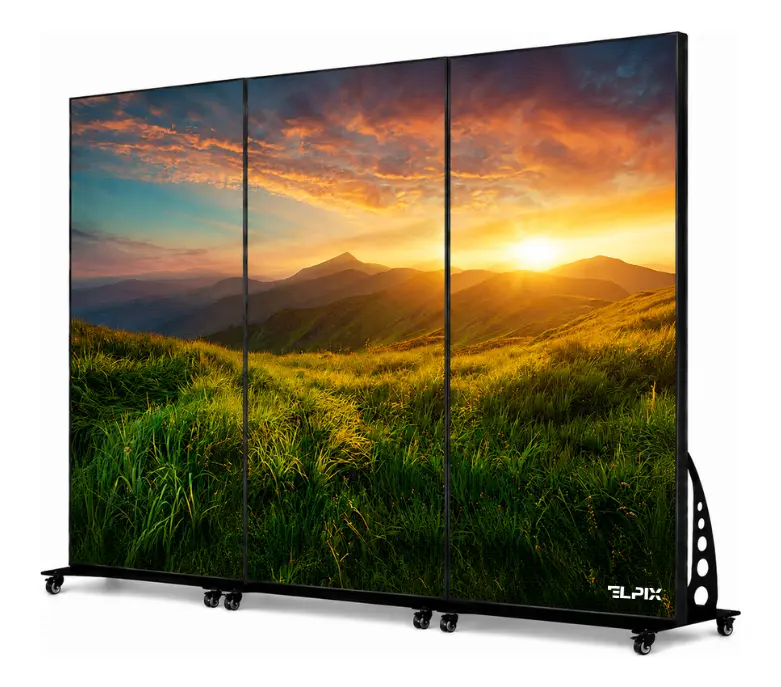
- Module format: an LED poster of 960×1920 mm; three side by side give a 2880×1920 mm canvas
The 3840 Hz refresh rate is an underrated figure. If an event involves filming or live streaming, a cheap LED wall with a low refresh rate produces rolling bands on video. Here that does not happen.
What follows from this: LED is the choice when the canvas is seen from a distance, when the room is bright and when the screen ends up on camera. For dense tables viewed up close it loses to LCD at the same budget.
Table: LCD video wall versus LED video wall
| Criterion | LCD video wall (55″ panels) | LED video wall (P1.5 / P2.5) |
|---|---|---|
| Seam between elements | thin bezel at the joint, visible up close | none at all, the canvas is continuous |
| Brightness | 500 cd/m² | up to 800 cd/m², some models up to 1000 |
| Detail up close | Full HD per panel, small text readable from 1 m | set by pixel pitch of 1.5 or 2.5 mm |
| Viewing angles | 178° / 178° | 140°, 160° on the P2.5 |
| On camera | depends on settings | 3840 Hz, no flicker on video |
| Service life | panel matrix life | over 100,000 hours |
| Repairability | a whole panel is replaced | a single module is replaced |
| Typical scenario | control room, situation centre, HQ | shopping centre, car showroom, expo, conference |
Mobility: both technologies travel, differently
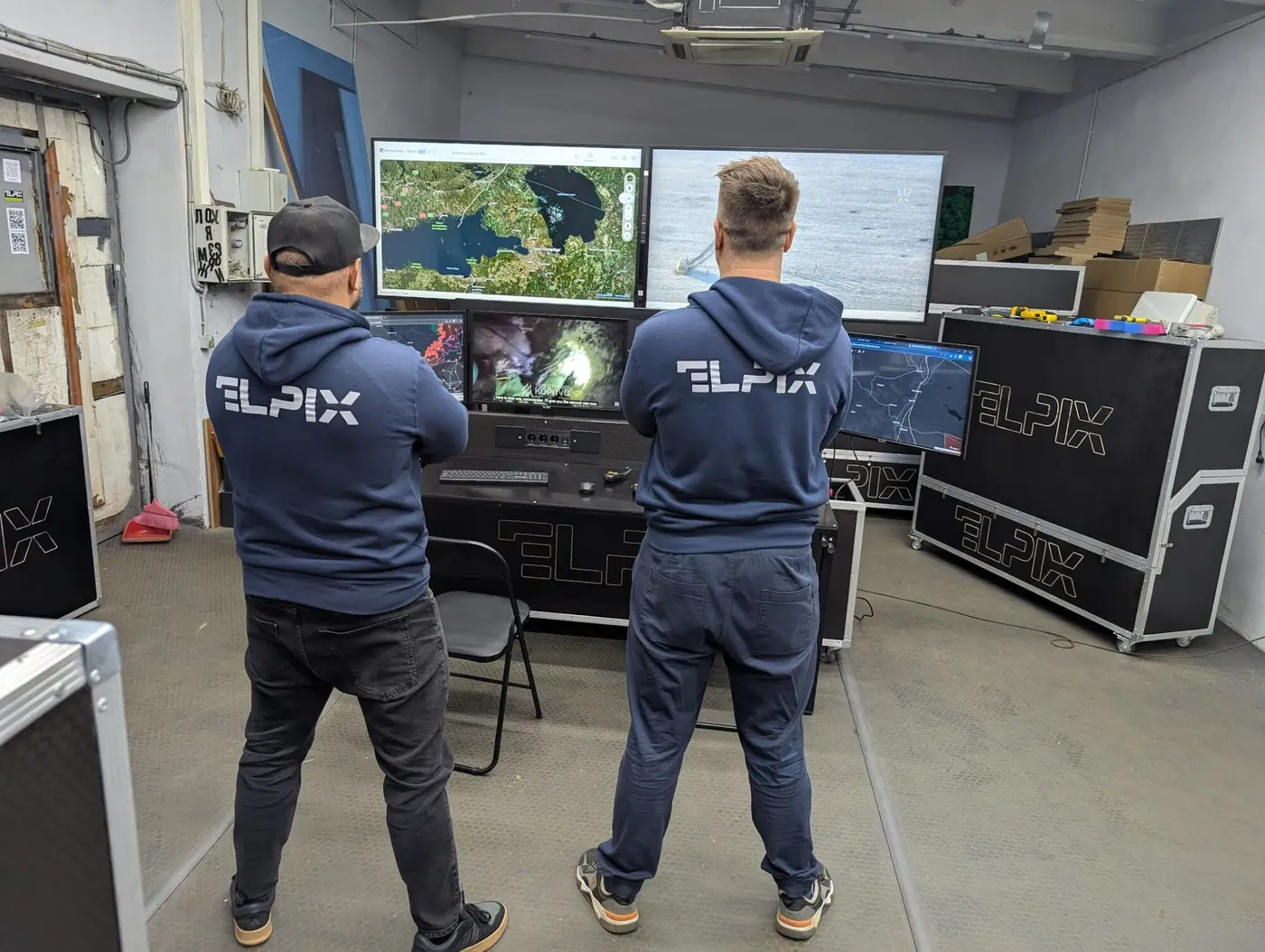
Elpix LCD video walls travel in transport cases, two displays per case, and the case becomes the base of the structure once deployed. The canvas goes up without anchors in the wall.
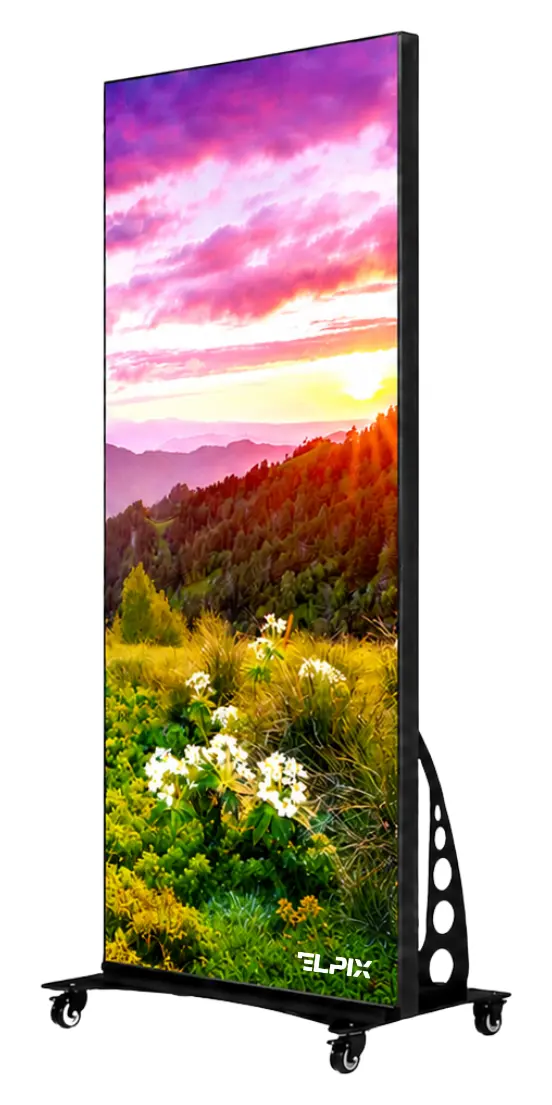
LED posters are mobile in a different way — each stands on its own wheeled base. They roll through a hall one by one and stand side by side when more area is needed. Three 960×1920 mm posters form a continuous 2880×1920 mm canvas, and the system expands further by adding modules.
What follows from this: a field headquarters is better served by cases, an exhibition stand by wheeled stands. Two kinds of mobility, not better and worse.
LED walls indoors and outdoors
The question comes up right after the technology is chosen: can this canvas go outside? It depends on the protection rating.
Elpix LED posters are rated IP30, and IP31 on the P2.5 model. That covers dust and brief splashes, which is an indoor specification: shopping centres, car showrooms, business-centre lobbies, exhibition halls. Rain and snow call for different enclosures and a different rating, which is a separate order.
Elpix LCD video walls in the mobile build are protected against impact, dust and water, with tempered glass over the panels. That is meant for transport and field work rather than for open weather — a command post in a tent or hangar differs from an office precisely in dust, vibration and temperature.
What follows from this: before comparing brightness and pixel pitch, settle where the canvas will stand. The protection rating eliminates half the options faster than any spec table.
How to choose: four questions that settle it
- From what distance will people watch? Closer than two metres — LED at 1.5 mm pitch. Three metres and beyond — LCD handles it.
- How much light is in the room? Panorama windows and direct sun — 800 to 1000 cd/m² of LED. A closed control room — 500 cd/m² is enough.
- What is being shown? Tables, maps, several camera windows — LCD. Clips, brand content, full-surface video — LED.
- Will the screen be filmed? If yes, only LED at 3840 Hz, otherwise the recording shows bands.
The fifth question is usually asked first: what does it cost. The honest answer is that at equal area LED costs more than LCD, and the gap widens as pixel pitch drops. A P1.5 module costs noticeably more than a P2.5 covering the same surface.
Common mistakes when choosing
- Putting a coarse-pitch LED where people walk right up to it. From two metres P2.5 looks great; from half a metre it falls apart into dots.
- Demanding zero seam from LCD. The technology cannot deliver it; the only questions are how thin the joint is and how the content is laid out.
- Saving on brightness in a bright hall. The canvas ends up behind blinds and the effect is gone.
- Ignoring maintenance. On LCD a failed panel means replacing the whole panel. On LED a single module is swapped, which is cheaper over time.
- Forgetting the controller. There are always more sources than planned at the start.
Three typical rooms and what goes into them
Theory gets clearer with examples. Three situations that come up most often.
A control room for six operators
People sit 1.5 to 3 metres from the canvas, watching maps, tables and camera feeds at once. Lighting is artificial, windows are few. LCD wins here: dense pixels, 178° on both axes and resolution that adds up across panels. A 4×2 build gives 7680×2160, which comfortably holds four or five windows.
A business-centre lobby or car showroom
Viewers pass by at three to ten metres, the hall has panorama windows and the content is clips and brand graphics. That is the LED scenario: 800 to 1000 cd/m², a continuous canvas with no joints, 2.5 mm pitch. Three posters forming 2880×1920 mm cover a typical lobby wall.
A travelling event or training session
The kit has to arrive, go up within an hour, do its job and leave. Here the structure decides rather than the technology: LCD in transport cases or LED posters on wheeled stands. Both assemble without anchors or wall fixings.
What follows from this: describe the room and the viewer first, then compare specifications. Most LCD-versus-LED arguments end on the first question about viewing distance.
What to ask a supplier before signing
- The refresh rate of the LED modules. If it is missing from the specification, treat that as a warning. Cheap modules run at 1920 Hz or lower and film badly.
- Whether spare modules are in stock. On LED this matters: a burnt-out module must be replaced with an identical one, otherwise a patch of different tone stays visible.
- Who calibrates the canvas after installation. A new LED wall almost always needs brightness and colour matched across modules.
- What the kit includes besides the screen. Controller, mounts, cables and stands are a real share of the budget and easy to miss in the first quote.
- What service life is claimed and on what basis. Elpix LED posters state over 100,000 hours, and that figure belongs in the specification, not in conversation.
Elpix equipment
LED and LCD solutions for large canvases
LED poster P2.5×3
Three modules in one seamless 2880×1920 mm canvas: up to 800 cd/m², 3840 Hz, wheeled stands.
View model
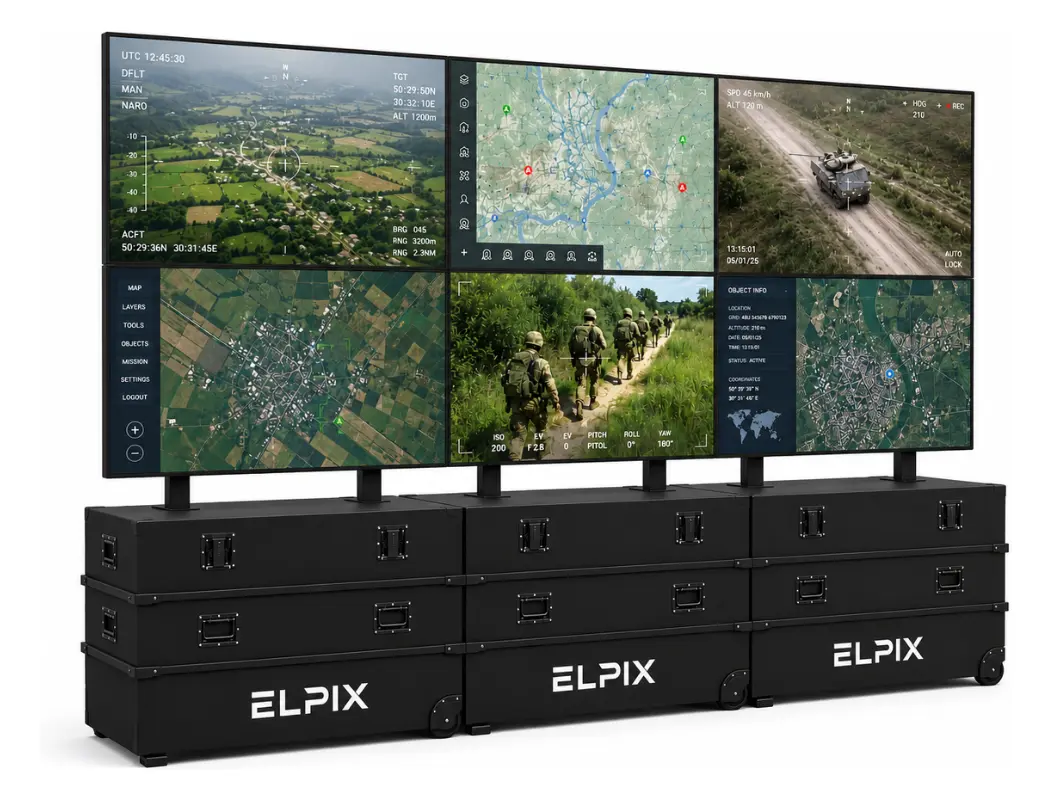
Elpix video wall 3×2, 6×55″
A 5760×2160 LCD canvas in three cases: control room or situation centre with 3–4 sources.
View model
LED poster P1.5
A 1.5 mm pixel pitch for close-up viewing; over 100,000 hours of service life, IP30.
View model
Elpix video walls: both technologies made in-house
Elpix designs and assembles both cased LCD video walls and module-based LED systems in Ukraine. That means the technology is matched to the task, instead of the customer being offered whatever sits in the warehouse.
- Matched to the scenario. Viewing distance, room lighting, content type and operating mode decide what goes in.
- Manufacturing and service in Ukraine. Module replacement and maintenance do not wait on imports.
- Hardened build. Mobile LCD systems carry impact, dust and water protection plus tempered glass.
- Public sector experience. The company works through public procurement procedures and prepares tender documentation as routine.
Configurations, specifications and current prices are in the catalogue — Elpix video walls. A quote needs three inputs: room size, viewing distance and the list of signal sources.